
Representativeness of Guaiacum (Zygophyllaceae) in the National System of Protected Areas of Cuba
Article Sidebar
Main Article Content
Abstract
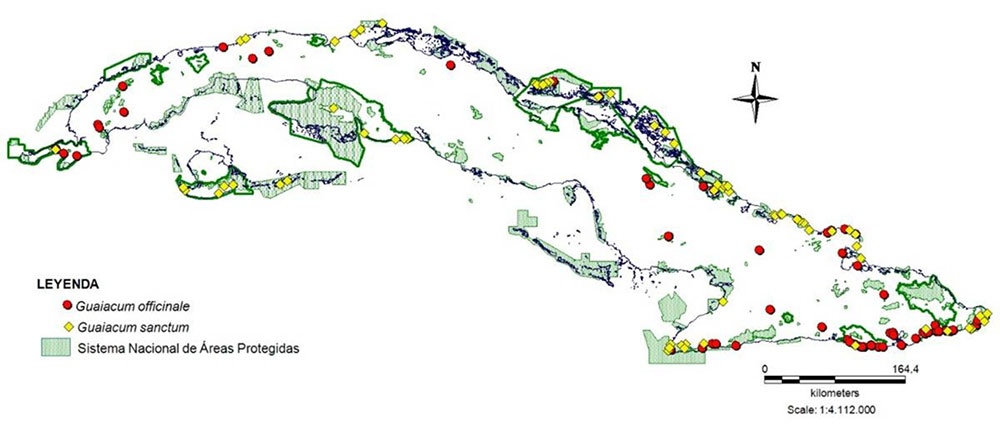
The genus Guaiacum was considered widely distributed in Cuba. Due to the exceptional qualities of the wood of the species represented in the country, they have been traditionally used in an unsustainable way, which together with the decrease in their habitats and illicit trade, G. officinale is currently considered threatened (without a specific threat category) and G. sanctum evaluated as Data Deficient. Knowledge about the state of their populations and their habitats is scarce, as well as what is related to the cultivation and propagation of these species. The work aimed to evaluate the coverage that the National System of Protected Areas (SNAP) of Cuba provides to them, give the interest they have for conservation, due to their degree of threat and their use value. The genus is distributed throughout the country, with the highest number of records in the south-eastern region and is represented in 40 areas (18.0%), of which seven are no legally declared. Guaiacum officinale tends to occupy locations further of the country, while G. sanctum is distributed in areas closer to the coast. Moreover, G. officinale and G. sanctum are present in 25 (11.7%) and 25 (11.2%) protected areas, respectively. The protected areas categories with the greatest representation of Guaiacum are Ecological Reserves, Wildlife Refuges and Protected Areas of Managed Resources. The representation of the genus in the SNAP does not exceed 50%, therefore, it is considered not adequately protected.
Article Details
Section

This work is licensed under a Creative Commons Attribution-NonCommercial 4.0 International License.
How to Cite
References
ACC-ICGC (Academia de Ciencias de Cuba-Instituto Cubano de Geodesia y Cartografía). 1989. Estudio de los grupos insulares y zonas litorales del archipiélago cubano con fines turísticos (Cayo Sabinal-Playa Santa Lucía). Editorial Científico-Técnica, La Habana.
ACC-ICGC (Academia de Ciencias de Cuba-Instituto Cubano de Geodesia y Cartografía). 1990. Estudio de los grupos insulares y zonas litorales del archipiélago cubano con fines turísticos. Cayos Francés, Cobos, Las Brujas, Ensenachos y Santa María. Editorial Científico-Técnica, La Habana.
Acevedo PR, Strong MT. 2012. Catalogue of seed plants of the West Indies. Smithsonian Contribution to Botany. 98:1-1192.
Acosta Z, García-Beltrán JA. 2021. Flora de las Sierras de Guane y de Paso Real, Pinar del Río, Cuba. Revista del Jardín Botánico Nacional. 42:137-155.
Albert D. 2017. Zygophyllaceae. En: Flora de la República de Cuba. Botanischer Garten und Botanisches Museum Berlin. Fascículo 22 (3):19.
Capote RP, Berazaín R. 1984. Clasificación de las formaciones vegetales de Cuba. Revista del Jardín Botánico Nacional. 5: 27-75.
CNAP-DGAP (Centro Nacional de Áreas Protegidas-Dirección General de medio Ambiente). 2024. Plan del Sistema Nacional de Áreas Protegidas 2023-2030. Ministerio de Ciencias Tecnología y Medio Ambiente, La Habana, Cuba.
CNAP (Centro Nacional de Áreas Protegidas). 2021. Base de datos de flora del Centro Nacional de Áreas Protegidas. Ministerio de Ciencia, Tecnología y Medio Ambiente, La Habana, Cuba.
Dudley N. 2008. Directrices para la aplicación de las categorías de gestión de áreas protegidas. IUCN, Gland, Suiza.
Fernández I, Blanco A, Cintra M, Leyva I, Matos Y. 2022. Composición florística y estructura de un matorral xeromorfo costero y subcostero en la zona semiárida, Guantánamo. Revista Cubana de Ciencias Forestales. 10: 74-92.
García-Beltrán JA, Bécquer ER, Gómez-Hechavarría JL, González-Torres LR. 2024. Catálogo de las Plantas de Cuba. Planta! - Plantlife Conservation Society, Vancouver. https://doi.org/10.70925/cat.2024.
GOC (Gaceta Oficial de Cuba). 2023. Resolución 92 Reglamento para el control de las especies de especial significación, los recursos genéticos de la diversidad biológica y las actividades con riesgo biológico. (GOC-2023-778-O87). Año CXXI.
GOC (Gaceta Oficial de Cuba). 2024. Decreto-Ley 83 del Sistema Nacional de Áreas Protegidas. (GOC-2024-255-EX23). Año CXXII.
González-Maya JF, Víquez LR, Belant JL, Ceballos JL. 2015. Effectiveness of protected areas for representing species and populations of terrestrial mammals in Costa Rica. PloS ONE 10(5): e0124480.
González-Torres LR, Palmarola A, González-Oliva L, Bécquer E, Testé E, Barrios D.2016. Lista roja de la flora de Cuba. Bissea 10 (NE1): 1-352.
Greuter W, Rankin R. 2023. Base de datos de especímenes de la Flora de Cuba con mapas de distribución. v. 16.0. Disponible en: https://ww3.bgbm.org/FloraOfCuba/index.php. (consultado: enero del 2023).
Grow S, Schwartzman E. 2001. Estudio de la taxonomía y distribución del género Guaiacum en México. En: XI reunión del Comité de Flora, Langkawi, Malasia (PC11 Doc. 8.2).
NYBG (Índice Herbariorum). 2024. Lista de herbarios. Jardín Botánico de Nueva York. Disponible en https://sweetgum.nybg.org/science/ih/herbarium-list/. (consultado: noviembre del 2024).
León Hno, Alain Hno. 1951. Flora de Cuba. Contribuciones Ocasionales del Museo de Historia Natural del Colegio De La Salle. II (10):354.
Méndez IE, Risco RA. 1999. Apuntes sobre la flora y vegetación de la Península de Pastelillo y la cayería de los Ballenatos, Nuevitas, Camagüey. Revista del Jardín Botánico Nacional. 20 :41-56.
Pérez NA, Polanco G, Brooks RM, Castell MA, Torres LM. 2023. Inventario florístico de El Prado de las Esculturas, Reserva de la Biosfera Baconao, Cuba. Acta Botánica Cubana. 222. https://cu-id.com/2402/v222e08.
Porter DM. 1972. The genera of the Zygophyllaceae in the Southeastern United States. Journal of the Arnold Arboretum. 53:531-532.
Rodríguez HL, Akcakaya R, Andelman SJ, Bakarr MI, Boitani L, Brooks TM, et al. 2004. Global gap analysis: priority regions for expending the global protected-area network. BioScience. 54:1092-1100.
Rosete S, Herrera P, Toscano BL, Menéndez S. 2000. Plantas de múltiples usos en Cuba. Acta Botánica Cubana. 181: 21-27.
Sánchez JA, Pernús M, Barrios D, Gutiérrez A. 2024. Protocolo para germinar y conservar semillas de plantas nativas cubanas: un enfoque con rasgos funcionales de semillas. Acta Botánica Cubana. 223. https://cu-id.com/2402/v223e08.
Sánchez JA, Pernús M, Torres-Arias Y, Barrios D, Dupuig Y. 2019. Dormancia y germinación en semillas de árboles y arbustos de Cuba: implicaciones para la restauración ecológica. Acta Botánica Cubana. 218: 77-108.
Sheahan MC. 2007. Zygophyllaceae. En: Kubitzki C. (ed.), The families and genera of vascular plants, 488-500, Berlin, Heidelberg y New York.
UICN. 2012. Directrices para el uso de los criterios de la Lista Roja de la UICN a nivel regional y nacional. Versión 4.0. Gland, Suiza y Cambridge.
Wolf D, Oldfield TEE, McGough N. 2018. Dictámenes de extracción no perjudicial CITES para la madera. v. 3.0. Disponible en: https://cites-tsp.org/wp-content/uploads/2021/02/CITESEsp_NDF_Guidance_for_Treesv3.pdf. (consultado: agosto del 2022).