
Potencial etnobiológico de los briofitos: una revisión sistemática con énfasis en las especies cubanas
Barra lateral del artículo
Contenido principal del artículo
Resumen
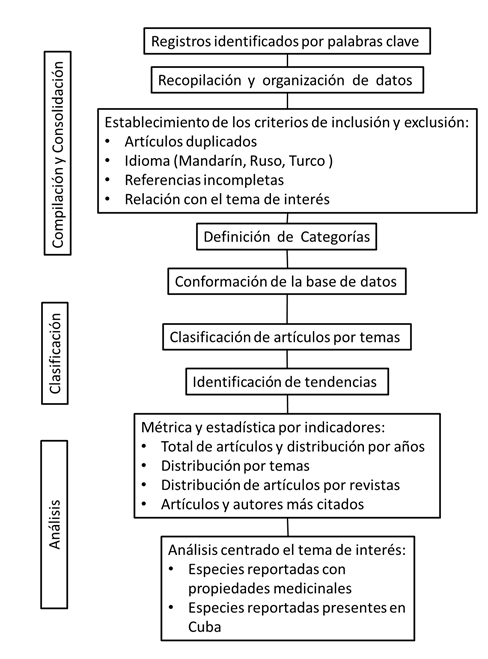
Los briofitos (antocerotas, hepáticas y musgos) son plantas no vasculares que han acompañado al hombre desde la antigüedad por sus diversos usos. La presente investigación tiene como objetivo contribuir a la comprensión de las tendencias sobre las investigaciones etnobiológicas en los briofitos a nivel mundial, con énfasis en sus usos medicinales. Se realizó un análisis bibliométrico utilizando las herramientas de meta-análisis. En la presente investigación se seleccionaron 256 artículos relacionados con los usos de los briofitos (5.2% del total de artículos consultados). De ellos, 51 han sido citados más de 500 veces (20%). Se reconocieron para los briofitos cinco Categorías de uso (18 subcategorías), donde las categorías Servicios Ambientales y Medicinal aparecen en el mayor número de artículos consultados. Se indican 133 especies de briofitos con sus referencias de uso, de ellas 20 están presentes en Cuba. Los estudios incluidos en esta revisión demuestran que los briofitos se utilizan ampliamente y su uso está estrechamente vinculado a la flora local, así como estudios realizados para medir el impacto que tiene el hombre sobre los ecosistemas.
Detalles del artículo
Sección

Esta obra está bajo una licencia internacional Creative Commons Atribución-NoComercial 4.0.
Cómo citar
Referencias
Aguirre Ceballos J, Rangel Churio JO, Avendaño K, Ruíz C, Sipman H. 2008. Musgos en la región Caribe. En: Aguirre Ceballos J, Rangel Churio JO (ed.), Colombia Diversidad Biótica VI: riqueza y diversidad de musgos y líquenes de Colombia, 55-59, Editorial Universidad Nacional de Colombia. Bogota.
Ah-Peng C, Cardoso AW, Flores O, West A, Wilding N, Strasberg, Hedderson TA. 2017. The role of epiphytic bryophytes in interception, storage, and the regulated release of atmospheric moisture in a tropical montane cloud forest. Journal of Hydrology. 548: 665-673.
Alam A. 2021. Potential of bryophytes in prevention and medication of COVID-19. Annals of Phytomedicine. 10: 121-129.
Alcorn JB. 1984. Huastec Mayan ethnobotany. University of Texas Press, Texas.
Asakawa Y. 2007. Biologically active compounds from bryophytes. Pure and Applied Chemistry. 79: 557-580.
Asakawa Y. 2008. Liverworts-potential source of medicinal compounds. Current Pharmaceutical Design. 14: 3067-3088.
Aydın S. 2020. The free radical scavenging activities of biochemical compounds of Dicranum scoparium and Porella platyphylla. Anatolian Bryology. 6: 19-26.
Azuelo AG, Sariana LG, Pabualan PM. 2011. Some medicinal bryophytes: their ethnobotanical uses and morphology. Asian Journal of Biodiversity. 2: 49-80.
Bailly C. 2023. Discovery and anticancer activity of the plagiochilins from the liverwort genus Plagiochila. Life. 13: 758.
Basile A, Giordano S, López-Sáez JA, Cobianchi RC. 1999. Antibacterial activity of pure flavonoids isolated from mosses. Phytochemistry. 52: 1479-1482.
Bates JW. (992. Mineral nutrient acquisition and retention by bryophytes. Journal of Bryology. 17: 223-240.
Bukvicki D, Gottardi D, Tyagi AK, Veljic M, Marin PD, Vujisic L, Vannini L. 2014. Scapania nemorea liverwort extracts: Investigation on volatile compounds, in vitro antimicrobial activity and control of Saccharomyces cerevisiae in fruit juice. LWT - Food Science and Technology. 55: 452-458.
Brinda, Atwood. 2025. The Bryophyte Nomenclator. Disponible en: https://www.bryonames.org/ (consultado: agosto de 2025).
Câmara PE, Teixeira R, Lima J, Lima J. 2003. Musgos urbanos do Recanto das Emas, Distrito Federal, Brasil. Acta Botanica Brasilica. 17: 507-513.
Chaudhary BL, Prem Kumar PK. 2011. Antibacterial activity and preliminary phytochemical screening of epiphytic moss Stereophyllum ligulatum Jaeg. Journal of Phytology. 3: 1-4.
Cianciullo P, Maresca V, Sorbo S, Basile A. 2021. Antioxidant and antibacterial properties of extracts and bioactive compounds in bryophytes. Applied Sciences. 12: 160.
Classification of the Bryophyta. 2020. Disponible en: http://bryology.uconn.edu/classification/ (consultado: agosto de 2025).
Costică M, Stratu A, Costică N. 2023. Liverworts and mosses from Romania with medicinal potential. Acta Biologica Marisiensis. 6: 113-127.
Cotton CM. 1996. Ethnobotany: Principles and applications. Wiley, London.
Crandall-Stotler B, Stotler RE, Long DG. 2009. Phylogeny and classification of the Marchantiophyta. Edinburgh Journal of Botany. 66: 155-198.
Cruz Arzola D, Miranda Martínez M, Torres Serna A, Oliva Romero M, Hernández M, Manso Hernández MC. 2014. Formulario nacional de fitofármacos y apifármacos. ECIMED, La Habana.
Decker EL, Reski R. 2008. Current achievements in the production of complex biopharmaceuticals with moss bioreactors. Bioprocess and Biosystems Engineering. 31: 3-9.
Delgadillo MC. 2000. Native moss names in Mexico. Evansia. 17: 8486.
Delgadillo MC, Escolástico OD, Hernández RE, Herrera PP, Retes AP, Juárez MC. 2022. Manual de briofitos (3ª ed.). Universidad Nacional Autónoma de México. Ciudad de México.
Dickson JH, Hofbauer W, Porley R, Schmidl A, Kofler, W, Oeggl K. 2009. Six mosses from the Tyrolean Iceman’s alimentary tract and their significance for his ethnobotany and the events of his last days. Vegetation History and Archaeobotany. 18: 13–22.
Dhondiyal PB, Pande N, Bargali K. 2013. Antibiotic potential of Lunularia cruciata (L.) Dum ex. Lindb (Bryophyta) of Kumaon Himalaya. African Journal of Microbiology Research. 7: 4350-4354.
Drobnik J, Stebel A. 2021. Four centuries of medicinal mosses and liverworts in European ethnopharmacy and scientific pharmacy: A review. Plants. 10: 1296.
Dulger B, Yayintas OT, Gonuz A. 2005. Antimicrobial activity of some mosses from Turkey. Fitoterapia. 76: 730-732.
Elibo B, Ezer T, Kara R, Çelik GY, Çolak E. 2011. Antifungal and antibacterial effects of some acrocarpic mosses. African Journal of Biotechnology. 10: 986-989.
Frahm JP, Enroth J, Koponen TJ, O’Shea B, Pocs T, Piippo SS, Rao P, Fang YM. 2003. Manual of tropical bryology. Tropical Bryology. 23: 39-48.
Frahm JP. 2004. Recent developments of commercial products from bryophytes. The Bryologist. 107: 277-283.
Glime JM. 2007. Bryophyte ecology Vol. 5. Uses. Michigan Technological University Michigan, .
Glime JM. 2017a. Gardening: Horticultural uses. J. M. Glime (Ed.), Bryophyte ecology, 1-30, Michigan Technological University, Michigan .
Glime JM. 2017b. Medical uses: Medical conditions J. M. Glime (Ed.), Bryophyte ecology, 1-22, Michigan Technological University, Michigan.
Glime JM. 2024. Roles of bryophytes in forest sustainability – Positive or negative? Sustainability. 16: 2359.
Goffinet B, Shaw AJ. 2009. Bryophyte biology (2ª ed.). Cambridge University Press, Cambridge.
Gradstein SR, Churchill SP, Salazar-Allen N. 2001. Guide to the bryophytes of tropical America. New York Botanical Garden Press, New York.
Guo L, Wu JZ, Han T, Cao T, Rahman K, Qin LP. 2008. Chemical composition, antifungal and antitumor properties of ether extracts of Scapania verrucosa Heeg. and its endophytic fungus Chaetomium fusiforme. Molecules. 13: 2114-2125.
Harris ES. 2008. Ethnobryology: Traditional uses and folk classification of bryophytes. The Bryologist. 111: 169-217.
Harzing AW. 2007. Publish or perish. Disponible en: https://harzing.com/resources/publish-or-perish (consultado: julio de 2025).
Ilhan S, Savaroğlu F, Çolak F, İşcen CF, Erdemgil FZ. 2006. Antimicrobial activity of Palustriella commutata (Hedw.) Ochyra extracts (Bryophyta). Turkish Journal of Biology. 30: 149-152.
Joshi S, Singh S, Sharma R, Vats S, Nagaraju GP, Alam A. 2022. Phytochemical screening and antioxidant potential of Plagiochasma appendiculatum Lehm. & Lindenb. and Sphagnum fimbriatum Wilson. Plant Science Today. 9: 986-990.
Kabadere S, Birgi F, Vatan PÖ, Işcen CF, İlhan S. 2021. Some biological activities of the moss Brachythecium populeum (Hedw.) Bruch, Schimp. & W. Gumbel (Bryophyta). Gazi University Journal of Science. 34: 1-9.
Karpınski TM, Adamczak A. 2017. Antibacterial activity of ethanolic extracts of some moss species. Herba Polonica. 63: 11-17.
Kiersch B, Mühleck R, Gunkel G. 2004. Las macrófitas de algunos lagos alto-andinos del Ecuador y su bajo potencial como bioindicadores de eutrofización. Revista de Biología Tropical. 52: 829-837.
Kimmerer RW. 2021. Gathering moss: A natural and cultural history of mosses. Oregon State University Press, Oregon.
Klavina L, Springe G, Nikolajeva V, Martsinkevich I, Nakurte I, Dzabijeva D, Steinberga I. 2015. Chemical composition analysis, antimicrobial activity and cytotoxicity screening of moss extracts. Molecules. 20: 17221-17243.
Lakshmi KP, Rao GN. 2023. Antimicrobial screening of the solvent extracts of Marchantia polymorpha against some pathogenic strains. Scholars Academic Journal of Biosciences. 11: 385-388.
Latinović N, Sabovljević MS, Vujičić M, Latinović J, Sabovljević A. 2019. Bryophyte extracts suppress growth of the plant pathogenic fungus Botrytis cinerea. Botanica Serbica. 43: 9-12.
López Sáez JA. 2002. Flavonoides en Bartramiaceae Schawaegr. (Musci, Bryophyta): aspectos quimiosistemáticos y de actividad biológica. Tesis de Doctorado. Universidad Complutense de Madrid.
Marko S, Aneta B, Dragoljub G. 2001. Bryophytes as a potential source of medicinal compounds. Pregledni Članak. 21: 17-29.
Marques RV, Sestito SE, Bourgaud F, Miguel S, Cailotto F, Reboul P, Moulin D. 2022. Anti-inflammatory activity of bryophytes extracts in LPS-stimulated RAW264.7 murine macrophages. Molecules. 27: 1940.
Mathew M, Mathew A. 2022. GC MS analysis of petroleum ether extract of Pterobryopsis pilifolia (Dixon) Magil to identify chemicals that offer antifeedant properties in bryophytes. Pollution Research. 41: 668-675.
Montaña AA. 2024. Apoyo a actividades de manejo, curaduría física y científica de las colecciones de referencia del herbario JBB, con énfasis en la colección de Briófitos. Tesis de Diploma. Instituto de Investigación de Recursos Biológicos Alexander von Humboldt. Bogotá.
Motito Á, Rivera Y. 2017. Briofitos. En: Mancina CA, Cruz DD (eds.), Diversidad biológica de Cuba: métodos de inventario, monitoreo y colecciones biológicas, 120-135, Editorial AMA, La Habana.
Motito-Marín Á, Rivera-Queralta Y, Mustelier-Martínez K. 2019. Caracterización de la brioflora en la reserva natural El Retiro, Santiago de Cuba, Cuba. Ciencia en su PC. 1: 15-26.
Motito-Marín Á, Queralta YR, Martínez KM. 2020. Los antoceros, hepáticas y musgos en el macizo montañoso Guamuhaya, Cuba. Acta Botánica Cubana. 219: 45-60.
Motito Marín Á. 2023. Revisión de la familia Phyllogoniaceae (Bryophyta) en Cuba. Revista del Jardín Botánico Nacional. 44: 89-102.
Motti R, Palma AD, De Falco B. 2023. Bryophytes used in folk medicine: An ethnobotanical overview. Horticulturae. 9: 137.
Mossang P, Chimyang N, Shankar V, Evelin H. 2021. Bryoflora of north-east India, Bioresources and sustainable livelihood of rural India, 241-262, Mittal Publications.
Muniz AR, Jesús LS, Marques EJ, Vale VL, Valente EB. 2023. Chemical and biological profile of the fractionated extract of the species Campylopus savannarum (Müll. Hal.) Mitt. Brazilian Journal of Biology. 83: e273243.
Navarrete H, De la Torre L, Muriel P, Macía MJ, Balslev H. 2008. Enciclopedia de las plantas útiles del Ecuador (con extracto de datos). Herbario QCA/PUCE & Herbario AAU. Quito
Nikolajeva V, Liepina L, Petrina Z, Krumina G, Grube M, Muiznieks I. 2012. Antibacterial activity of extracts from some bryophytes. Advances in Microbiology. 2: 345-349.
Oztopcu-Vatan P, Savaroglu F, Iscen CF, Kabadere S, Ozturk N, Ilhan S. 2017. Screening of antimicrobial, cytotoxic effects and phenolic compounds of the moss Aulacomnium androgynum (Hedw.) Schwagr (Bryophyta). Journal of Animal and Plant Sciences. 27: 1909-1917.
Pandey S, Alam A. 2020. Bryo-pharmaceuticals En: Singh, Singh, Bithel N (eds.), Advanced pharmacological uses of medicinal plants and natural products, 269-284, IGI Global.
Pejin B, Bogdanovic-Pristov J, Pejin I, Sabovljevic M. 2013. Potential antioxidant activity of the moss Bryum moravicum. Natural Product Research. 27: 900-902.
Peñate-Pacheco L, Gil-Novoa JE, Carrillo-Fajardo MY. 2022. Diversidad taxonómica y funcional de briófitos en diferentes coberturas de un bosque seco tropical, Córdoba (Colombia). Boletín de la Sociedad Argentina de Botánica. 57: 1-10.
Purkon DB, Fadhlillah FM, Maigoda TC, Iwo MI, Soemardji AA, Nadhifah A, Sudaryat Y. 2022. Phytochemical, use in ethnomedicine, and therapeutic activities of Marchantia genus. Journal of Vocational Health Studies. 5: 174-185.
Reyes-Tur B, Alonso Bosch R, Bécquer ER, García-Beltrán JÁ. 2023. Cuba: Biodiversity, conservation and evolution. Biological Journal of the Linnean Society. 140: 319-322.
Rivera-Queralta Y. 2023. Inventario de las antocerotas (Anthocerotophyta) de Cuba. Revista del Jardín Botánico Nacional. 44: 157-163.
Rivera-Queralta Y, Marín ÁM, Martínez KM. 2021. Diversidad briológica en agroecosistemas al sur de las sierras de Nipe y del Cristal, Cuba. Revista del Jardín Botánico Nacional. 42: 259-267.
Rodrigues CK, Ethur EM, Scheibel T, de Moura NF. 2020. Evaluation of the antimicrobial activity of ethanol extracts from Orthostichella rigida (Müll. Hal.) BH Allen Magill (Bryophyta) on pathogenic microorganisms. Journal of Medicinal Plants Research. 14: 98-104.
Roig JT. 1945. Plantas medicinales, aromáticas o venenosas de Cuba. Editorial Cultural S.A.
Ruíz Molina N. 2015. Establecimiento de un cultivo en suspensión del musgo Polytrichum juniperinum y evaluación de su potencial para la producción de compuestos bioactivos. Tesis de doctorado. Universidad de Chile.
Sabovljevic M, Papp B, Sabovljević A, Vujičić M, Szurdoki E, Segarra-Moragues JG. 2012. In vitro micropropagation of rare and endangered moss Entosthodon hungaricus (Funariaceae). Journal of Bryology. 34: 267-274.
Sánchez-Meca J. 2010. Cómo realizar una revisión sistemática y un meta-análisis. Aula Abierta. 38: 53-64.
Santos RD, Lisboa RC. 2008. Musgos (Bryophyta) da Microrregião do Salgado Paraense e sua utilização como possíveis indicadores de ambientes perturbados. Rodriguésia. 59: 361-368.
Savaroglu, F., Ilhan, S., & Filik-Iscen, C. (2011). An evaluation of the antimicrobial activity of some Turkish mosses. Journal of Medicinal Plants Research. 5: 3286-3292.
Savaroglu F, Oztopcu-Vatan P, Kabadere S, Ozturk N, Ilhan S, Iscen CF. 2018. Screening of antimicrobial, cytotoxic effects and phenolic compounds of the moss Dicranum scoparium. Biological Diversity and Conservation. 11: 87-94.
Savoretti A, Ponce JF. 2020. Briofitos de Tierra del Fuego: Pequeñas plantas, grandes actores ecológicos. La Lupa. Colección Fueguina de Divulgación Científica. 17: 34-38.
Saxena D, Harinder. 2004. Uses of bryophytes. Resonance. 9: 56-65.
Semerjyan I, Semerjyan G, Semerjyan H, Trchounian A. 2020. Antibacterial properties and flavonoids content of some mosses common in Armenia. Iranian Journal of Pharmaceutical Sciences. 16: 31-42.
Sharma A, Flores-Vallejo RD, Cardoso-Taketa A, Villarreal ML. 2017. Antibacterial activities of medicinal plants used in Mexican traditional medicine. Journal of Ethnopharmacology. 208: 264-329.
Singh M, Rawat AK, Govindarajan R. 2007. Antimicrobial activity of some Indian mosses. Fitoterapia. 78: 156-158.
Tavares-Martins AC, Lisboa RC, Costa DP. 2014. Bryophyte flora in upland forests at different successional stages and in the various strata of host trees in northeastern Pará, Brazil. Acta Botanica Brasilica. 28: 46-58.
Toledo VM, Barrera-Bassols N, Boege E. 2019. ¿Qué es la diversidad Biocultural? UNAM/Red Patrimonio Biocultural. Disponible en: https://patrimoniobiocultural.com/producto/que-es-la-diversidad-biocultural/ (consultado: julio de 2025)
Tosun G, Yayli B, Özdemir T, Batan N, Bozdeveci A, Yayli N. 2015. Volatiles and antimicrobial activity of the essential oils of the mosses Pseudoscleropodium purum, Eurhynchium striatum, and Eurhynchium angustirete grown in Turkey. Records of Natural Products. 9: 237-243.
Tuba Z, Slack NG, Stark LR. 2011. Bryophyte ecology and climate change. Cambridge University Press, Trinity Lane Cambridge.
Vanderpoorten A, Goffinet B. 2009. Introduction to bryophytes. Cambridge University Press, Trinity Lane Cambridge
Vats S, Alam A. 2013. Antibacterial activity of Atrichum undulatum (Hedw.) P. Beauv. against some pathogenic bacteria. Journal of Biological Sciences. 13: 427-431.
Vidal CAS, Sousa EO, Rodrigues FFG, Rolim A. 2012. Phytochemical screening and synergistic interactions between aminoglycosides, selected antibiotics and extracts from the bryophyte Octoblepharum albidum Hedw. Archives of Biological Sciences. 64: 465-470.
Wang D, Zhu RL, Qu L. 2006. Antibacterial activity in extracts of Cylindrocolea recurvifolia (Cephaloziellaceae, Marchantiophyta) and Pleurozia subinflata (Pleuroziaceae, Marchantiophyta). Cryptogamie, Bryologie. 27: 343-347.
Yuan-Yuan Ch, Yu-Xia L, Shuiliang G, Tong C. 2009. Succeessful tissue culture of the medicinal moss Rhodobryum giganteum and factors influencing proliferation of is protonemata. Annales Botanici Fennici. 46: 516-524.
Zhu RL, Wang D, Xu L, Shi RP, Wang J, Zheng M. 2006. Antibacterial activity in extracts of some bryophytes from China and Mongolia. Journal of the Hattori Botanical Laboratory. 100: 603-615.