
Conservation and resilience of plant formations in the Central-West Cayo Coco Ecological Reserve
Article Sidebar
Main Article Content
Abstract
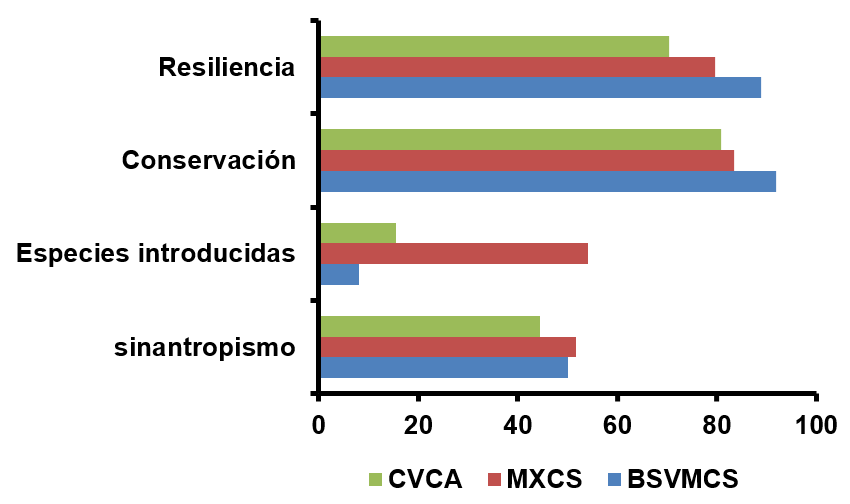
The application of ecological indicators in the vegetation formations under study showed that the coastal and subcoastal xeromorphic shrubland presented the highest synanthropism although also the highest number of introduced taxa, while in the forest the lowest number of introduced taxa and better state of conservation and resilience were observed. In the evergreen coastal and subcoastal microphyll forest, the native synanthropic taxa predominated, mainly the primary intraphytes (24.4%), normal extrapophytes (20%) and recovering intraphytes (17.8%); in the coastal and subcoastal xeromorphic shrubland, the secondary extrapophytes (27.3%); and in the sandy coast vegetation complex, the primary intraphytes (25%). The strong presence of native synanthropic species in these formations showed their high capacity for resilience. These species adapted to disturbances while maintaining the stability of the vegetation. The native taxa increased the number of individuals in the early stages of succession and persisted as dynamic equilibrium was established in the ecosystem. In the territory, only 5.7% of invasive species were listed, of which 1.3% were potentially invasive. The small number of introduced taxa and invasive species showed that despite the disturbances that occurred, the level of impact was low.
Article Details
Section

This work is licensed under a Creative Commons Attribution-NonCommercial 4.0 International License.
How to Cite
References
Caley MJ, Buckley KA, Jones GP. 2001. Separating ecological effects of habitat fragmentation, degradation, and loss on coral comensals. Ecology. 82: 3435-3448.
Collins RJ, Barrett GW. 1997. Effects of habitat fragmentation on meadow vole (Microtus pennsylvanicus) population dynamics in experiment landscape patches. Landscape Ecology. 12: 63-76.
Collinge SK, Forman RTT. 1998. A conceptual model of land conversion processes: predictions and evidence from a microlandscape experiment with grassland insects. Oikos 82: 66-84.
Costanza R, Mageau M. 1999. What is a healthy ecosystem? En: Kumpf H, Steidinger K, Kenneth S. (eds.), 385-430, Blackwell Science.
Cortes D. 2024. Índice de Salud Vegetal: Cómo medirlo con tecnología. Tecnología en la Agricultura. Disponible en: https://www.tecnologiaagricola.com (consultado: octubre de 2025).
Debinski DM, Holt RD. 2000. A survey and overview of habitat fragmentation experiments. Conservation Biology. 14: 342-355.
Fahrig L. 2003. Effects of habitat fragmentation on biodiversity. Annual Review of Ecology and Systematics. 34: 487-515.
García Rivera EE, Herrera P. 2011. Nivel de sinantropismo y potencialidad de uso de la flora del Archipiélago de los Canarreos, Cuba. Acta Botánica Cubana. 210: 1-25.
Holling CS. 1973. Resilience and stability of ecological systems. Annual Review of Ecology and Systematics. 4: 1-23.
Lindenmayer DB, Margules CR, Botkin DB. 2000. Indicators of biodiversity for ecologically sustainable forest management. Conservation Biology, 14(4):941-950.
Oviedo Prieto R, González-Oliva L. 2015. Lista nacional de plantas invasoras y potencialmente invasoras en la República de Cuba. Bissea 9 (NE 2): 1-88.
Priego-Santander ÁG, Ribot Guzmán M. 2025. Mapa de vegetación de Cayo Coco. En: Curso Taller sobre valoración funcional de bienes y servicios ambientales. (7-13 julio 2025), Cayo Coco, Ciego de Ávila, Cuba.
Pyšek P, Richardson DM, Rejmánek M, Webster GL, Williamson M, Kirschner J. 2004. Alien plants in checklists and floras: towards better communication between taxonomists and ecologists. Taxon. 53:131-143.
Ricardo Nápoles N. 2007. Sinantropización como indicador de la salud del bosque siempreverde de la Reserva de la Biosfera Sierra del Rosario. Acta Botánica Cubana. 197: 28-37.
Ricardo Nápoles N. 2016. Indicadores ecológicos que evalúan el estado de antropización: conservación de las formaciones vegetales, ecosistemas, paisajes y territorios. Acta Botánica Cubana. 215: 328-335.
Ricardo Nápoles N, Fundora Caballero D, Priego Santander AG, Ribot Guzmán M, Milanés M, Rodríguez L, Socarrás E. 2026. Actualización de la flora y vegetación de Cayo Coco, Ciego de Ávila, Cuba, a escala 1:50 000. Acta Botánica Cubana (en prensa).
Ricardo Nápoles N, Herrera P. 2017. Especies vegetales exóticas y nativas que invaden ecosistemas vulnerables en Cuba. Centro Nacional de Áreas Protegidas (CNAP), La Habana.
Ricardo Nápoles N, Herrera Oliver P, Cejas Rodríguez F, Cabrera Herrera L, 2009. Grupos morfológico-funcionales de la flora que tipifican la Altiplanicie El Toldo, Cuba. Acta Botánica Cubana 204:1-13.
Ruiz I. 2019. Las Áreas Protegidas de Cuba. Centro Nacional de Áreas Protegidas, La Habana,
Wilcove DS, McLellan CH, Dobson AP. 1986. Habitat fragmentation in the temperate zone. En: Soule ME. (ed.), 237-56, Conservation Biology. Sunderland, MA, Sinauer.
Zulueta E, Valladares M, Milanés M, Martínez O, Fundora D, Bravo F, Matos F. 2022. Plan de Manejo 2022- 2026 Reserva Ecológica Centro y Oeste de Cayo Coco, Empresa Flora y Fauna, Ciego de Ávila y Sistema Nacional de Áreas Protegidas, Ministerio de Ciencia, Tecnología y Medio Ambiente, Cuba.